






AI vs Human Jobs: Which Careers Are Safe in the Next 10 Years?
Let’s be real – the conversation around artificial intelligence has moved from “Is it coming?” to “What do I do now?” As we settle into 2026, it’s clear that AI...

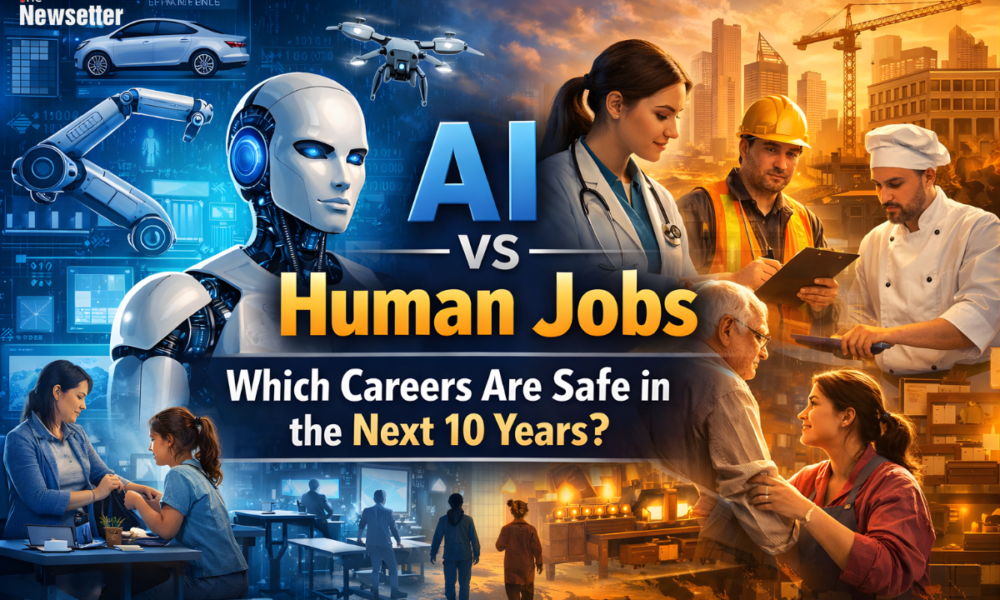
Let’s be real – the conversation around artificial intelligence has moved from “Is it coming?” to “What do I do now?” As we settle into 2026, it’s clear that AI isn’t just a niche tool anymore; it’s a fundamental shift in how the world actually works. Naturally, that brings up a lot of anxiety about AI job replacement. But here’s the good news: the next ten years aren’t necessarily about the “end of work.” Instead, we’re seeing a big shift toward roles that require a uniquely human touch.
Table Of Content
We must examine the things AI simply cannot accomplish in order to determine the number of jobs safe from AI. For starters, it lacks the moral intuition required for critical decisions, it is incapable of experiencing true empathy, and it struggles to navigate unpredictably chaotic physical environments. The workforce landscape for the upcoming ten years is discussed below.
The Rise of Empathy and Real Connection
The healthcare industry is at the top of the list if you’re searching for jobs safe from AI. This especially applies to those jobs that include mental health and direct patient care. Undoubtedly, an AI can swiftly assess a medical scan or suggest a drug dosage, but it is unable to sit down with a patient and sympathetically explain a difficult diagnosis.
An algorithm simply cannot replace the emotional labor performed by psychologists, social workers, and specialty nurses. These positions require a thorough comprehension of culture, human subtext, and that sixth sense of emotional intelligence. As we all seek genuine personal connections to counterbalance our digital lives, these positions will grow even more valuable over the next ten years.
Skilled Trades and the Messiness of Real Life
There’s a big misconception that white-collar office jobs are safer than blue-collar trades. In reality, the opposite is often true. Those high-level office roles involving data and spreadsheets are much more vulnerable to AI job replacement than the skilled trades.
Think about it: plumbers, electricians, and mechanics work in totally unpredictable environments. Every pipe arrangement is different, every house is a puzzle, and every repair requires a combination of quick thinking and fine motor abilities. It will still be decades before robots can rewire an old structure or crawl into a crowded basement like a human. These are the classic future-proof careers because they combine physical street smarts with real-time decision-making.
Strategic Leadership and Having a Moral Compass
In the corporate and legal worlds, the middle stuff – the research and the first drafts – is already being automated. But the final call? That has to be human. High-level strategists, CEOs, and judges must consider ethics, public opinion, and the project’s long-term viability in addition to statistics.
An AI can give you a thousand different business models, but it can’t decide which one is the right thing to do for the community. Leadership is about trust and accountability, and that’s a deeply human endeavor. People who can bridge the gap between AI-generated data and a human-centered strategy are going to be in a very secure spot.
Education and Mentorship
While we have some amazing AI tutors these days, the role of a teacher is evolving into something more like a mentor. Education isn’t just about dumping information into a brain; it’s about sparking curiosity, managing the energy of a room, and helping a student find their specific path. Future-proof careers in education will belong to those who can teach critical thinking, ethics, and how to learn – skills that will matter more than ever as technology keeps changing under our feet.
Conclusion: Teaming Up Instead of Competing
The fear of AI job replacement is valid, but history usually shows that technology creates more opportunities than it kills – as long as we’re willing to adapt. The most successful people in the next decade won’t be the ones trying to out-calculate the AI; they’ll be the ones who learn how to team up with it.
One thing is always the same when searching for jobs safe from AI: look for the human aspect. You’re on solid ground if your profession demands you to take care of others, develop, lead, or mend complicated things with your own hands. Although there will be a lot of technological change over the next ten years, the future appears amazingly bright if you focus on your human strengths.




[…] AI vs Human Jobs: Which Careers Are Safe in the Next 10 Years? […]